
Spring/Mill (Championship) Course
Philadelphia Country Club


About this course
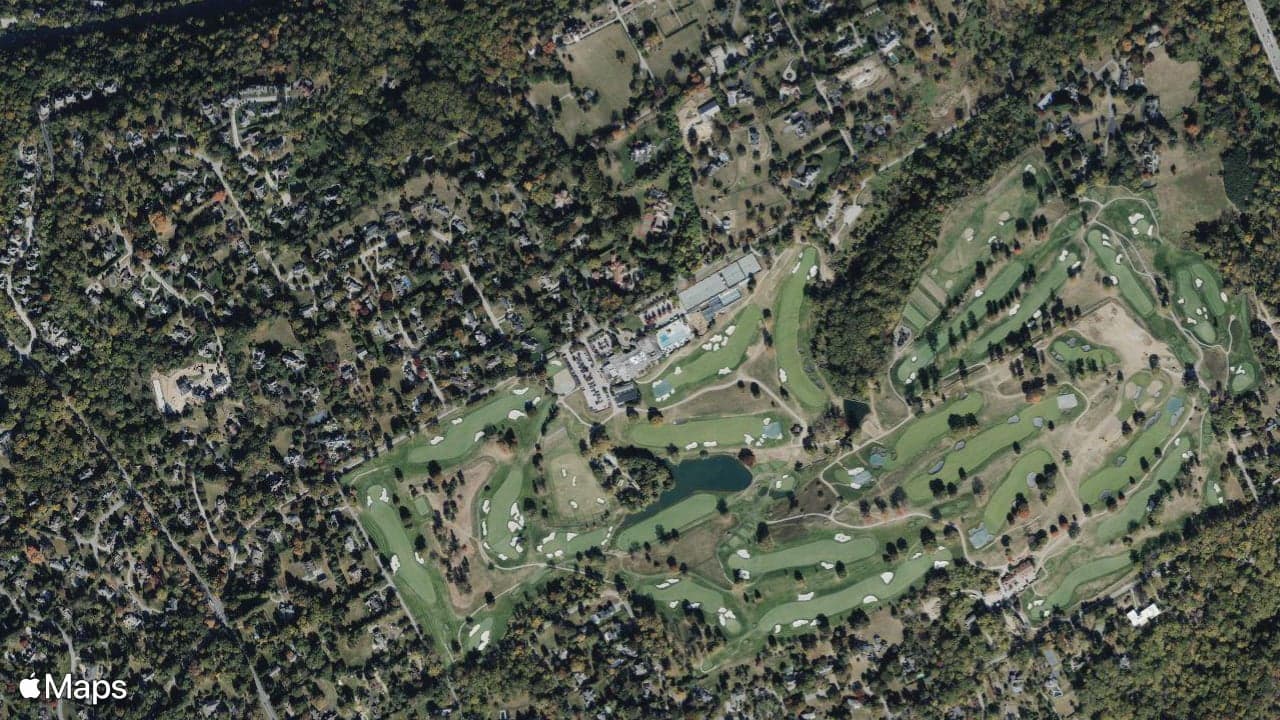
The horse came first. Before there was a fairway at Philadelphia Country Club there was a polo field. John C. Bullit formed the club in 1890 on a sixty-acre property at Bala Cynwyd, and the horse head that still rides on the club emblem is the quiet proof of it. Golf arrived two years later as a nine-hole course beside the polo ground, and it took hold fast. The club became the seventh member of the USGA in the 1890s, and in 1899 Ruth Underhill won the fifth U.S. Women's Amateur on that Bala course. The course is gone now, its holes vanished, which gives the club a strange inheritance: a championship past rooted in a place no one can walk anymore. When the club went looking for room in 1926, it found it at Gladwyne, and it left the polo behind. What it carried forward was ambition. The firm of William S. Flynn and Howard C. Toomey designed an eighteen-hole course on the new land in the late 1920s, and it opened in 1930 as the Spring Mill course. To think about golf in Philadelphia is to think about Flynn. Here his style was championship golf, demanding high-quality play and strength in every part of the game. The land did much of the talking. There is a low middle valley and a high ridge, and Flynn routed his holes around them with a kind of showman's confidence, making bold use of the ground's movement. The bunkers are flashy, meant to be seen. Stand on the modest par-4 first and the sand catches your eye before anything else does, recalling the bunkers on the 16th at Lancaster Country Club, another Flynn course. That first hole was not always first. The clubhouse once sat at the south end of the property, and the round began on what is now the 14th. In today's numbers, the original journey ran 14, 15, 16, 17, 18, then 10 through 13, then 4 through 9, and finally 1, 2 and 3. So the opening hole a member plays today was once the 16th, a late test rather than a handshake. Only the numbers changed, and Flynn's original drawings, with his own hole numbers, can still be found in the men's locker room by anyone curious enough to trace the older walk. The course proved itself quickly. In 1939 the U.S. Open came to Gladwyne, and Byron Nelson won it only after a 36-hole playoff. Then came a long silence before elite championships returned with the U.S. Women's Amateur in 2003. It was a homecoming of sorts for a club whose first great moment had been that same event on long-lost ground. In 2005 Philadelphia shared stroke play for the U.S. Amateur with Merion, and it played that role again in the summer of 2026, when the Amateur came back to the city. A club this old could easily have let its architecture drift. Instead it chose to look backward on purpose, finishing a refurbishment that restored the course to the playing conditions its architect intended some eighty years earlier. The eighteen holes remain in their original form, and Flynn's movement and nerve read as clearly now as when the course was new. The club kept growing around that core. For its hundredth year in 1990, Tom Fazio built another nine, the Centennial Nine, making a 27-hole complex that sits alongside tennis and squash courts, a swimming pool, a shooting lodge and a bowling alley. It is the full life of a club. But the heart of the place is still that ridge and valley, that bright sand on the first, and a set of holes that remember being played in a different order.
Quick facts
- Location
- Gladwyne, PA, USA
- Access
- Private
- Year built
- 1927
- Holes
- 18
- Designer(s)
- Tom Fazio, William S. Flynn, Howard C. Toomey
- Par
- 71
- Length
- 6,976 yards
- Difficulty
- 74.7/144
- Course Vaults score
- 8.6
Getting there
Philadelphia Country Club rests in the leafy enclave of Gladwyne, a brief twenty-minute drive northwest from Philadelphia International Airport along the Schuylkill Expressway and into the verdant estates of the Main Line. The route traces the river valley before climbing into Montgomery County's wooded hills, where stone walls and discreet gates mark the transition from city to country. For members arriving by private aircraft, Wings Field in nearby Blue Bell offers a quiet alternative, placing you within fifteen minutes of the club's understated entrance. The final turn off Montgomery Avenue reveals little from the road - only a glimpse of manicured fairways through the trees, befitting a club that has kept its counsel since 1890.
FAQ
Common questions about Spring/Mill (Championship) at Philadelphia Country Club
Ratings, design, and course details pulled from Course Vaults.
Spring/Mill (Championship) at Philadelphia Country Club has a Course Vaults score of 8.6 out of 10 based on 77 logged golfers.
Spring/Mill (Championship) was designed by Tom Fazio, William S. Flynn, and Howard C. Toomey.
Spring/Mill (Championship) at Philadelphia Country Club is listed as private on Course Vaults; guest access is typically restricted.
Par at Spring/Mill (Championship) is 71.
Spring/Mill (Championship) plays 6,976 yards from the back tees on Course Vaults.
The slope rating at Spring/Mill (Championship) is 144.