

Championship Course
Royal Dornoch Golf Club


Public: #1

Public: #1
Public: #1


About this course
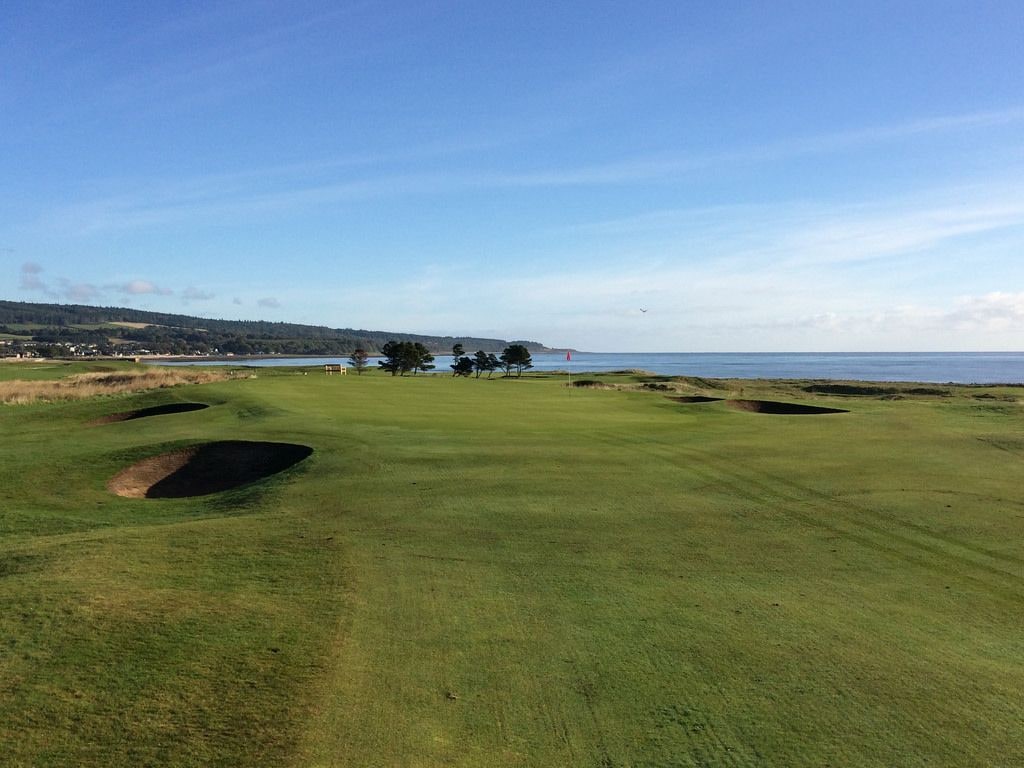
Golf has a way of arriving late to its own best places, and Royal Dornoch is the proof. Golf was already being played along this strip of Highland coast in 1616. By 1630 Sir Robert Gordon was claiming that its fields did "surpass the fields of Montrose or St Andrews." Yet the first club, a nine-hole one, was not founded until 1877, and for much of the twentieth century the links stayed almost a secret outside Scotland. The road north still asks something of you: about four hours by car even from Glasgow. Bernard Darwin left it too late, and he mourned the gap: "And then, alas! - worst of all the deficiencies in my education - there is Dornoch. I never seem yet to have enough time or enough money to get so far north." What waits at the end of that road is wild, isolated and absolutely beautiful. A pure white beach runs between the links and the Dornoch Firth. The sea shows itself from almost everywhere on the ground. In early summer the gorse blazes with colour. The plan looks straightforward, out and back, but the land is not simple. It carries big changes in elevation and riotous, human-sized undulations. Pot bunkers are well placed, many greens sit on natural raised plateaux, and the putting surfaces roll large and wide. Old Tom Morris came in 1886. He updated the original nine and drew up a plan for eighteen, and three years later he returned to extend the course to eighteen holes. The stretch from 14 through 17 is his, and it sits near the heart of the place. The 14th, Foxy, is a long par four of almost 445 yards. It is one of the most simple and natural holes in golf, and it ends on a classic domed green. That green belongs to a lineage. Donald Ross was born in Dornoch in 1872 and kept the green here in the 1890s as head greenkeeper and professional. He later emigrated to the States and became one of the great golf course architects, and many of his designs, Pinehurst No. 2 above all, bear the mark of Dornoch's raised, domed greens. In 1921 he proposed a redesign of the first two holes, and it was carried out in 1927. Between 1904 and 1907 J.H. Taylor spent his summers here, revising and lengthening the course with guidance from the club secretary, John Sutherland. Then the war took a bite. The Air Ministry requisitioned part of the club's land, and six holes south of the clubhouse, then Nos. 13 through 18, were flattened, while that old 13 to 18 also became part of the new Struie course. In 1948 greenkeeper Robbie Grant and the Open champion George Duncan replaced them by carrying the routing up, over and back around the bluff at the north end. Today's 6th through 11th are theirs. The 6th, Whinny Brae, marks the turn from low holes to high ones: a par three across a swathe of gorse that wraps around its plateau green. Before it, the 4th sits in the middle of a fine run of three par fours, its tee line aimed at the statue of the Duke of Sutherland. The modern era has leaned toward restoring. In 2017 Tom Mackenzie oversaw in-house improvements to the 5th, 10th, 11th and 12th. A new 7th followed and opened in 2020. It runs closer to the edge of the escarpment now, with the old gorse cleared so the coast stays in view the whole way, and its green is shaped to the exact dimensions of the one it replaced. New tees on the site of the old 7th green let golfers play from the top of the hill, as Old Tom Morris intended. In shifting the 7th, the 8th became a longer, dogleg-right par four. Then, over the winter of 2022, the club's own crew removed hundreds of tons of soil and gorse to open the views beyond the green below, pushing the tees toward the old 7th green. Most approaches are once again played from the top of the escarpment, as first envisaged. A new three-storey clubhouse opened in December 2025. It is spacious and comfortable inside and distinctly modern outside, a new building set beside very old ground.
Quick facts
- Location
- Dornoch, The Highlands, Scotland
- Access
- Public
- Year built
- 1886
- Holes
- 18
- Designer
- George Duncan
- Par
- 70
- Length
- 6,754 yards
- Difficulty
- 77.3/142
- Course Vaults score
- 9.7
Getting there
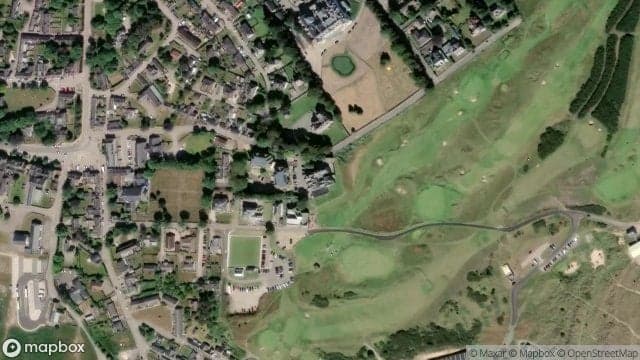
The pilgrimage to Royal Dornoch Golf Club begins at Inverness Airport, a compact Highland gateway roughly an hour's drive north along the A9 and across the Dornoch Firth. The route traces the edge of the Cromarty Firth before climbing inland through rolling moorland and forestry, then descending toward the coast where the medieval burgh of Dornoch appears like a mirage of stone and spire. As you cross the graceful span of the Dornoch Bridge, the links unfold along the shoreline to your left - a rumpled ribbon of duneland pressed between the North Sea and the town, as remote and unhurried as Scottish golf gets. The clubhouse, modest and welcoming, sits just beyond the cathedral square, a quiet threshold to one of the game's most revered grounds.
FAQ
Common questions about Championship at Royal Dornoch Golf Club
Ratings, design, and course details pulled from Course Vaults.
Championship at Royal Dornoch Golf Club has a Course Vaults score of 9.7 out of 10 based on 228 logged golfers.
Championship was designed by George Duncan.
Yes. Championship at Royal Dornoch Golf Club is listed as welcoming public or guest play on Course Vaults.
Par at Championship is 70.
Championship plays 6,754 yards from the back tees on Course Vaults.
The slope rating at Championship is 142.