
Yale Course
The Course at Yale


About this course
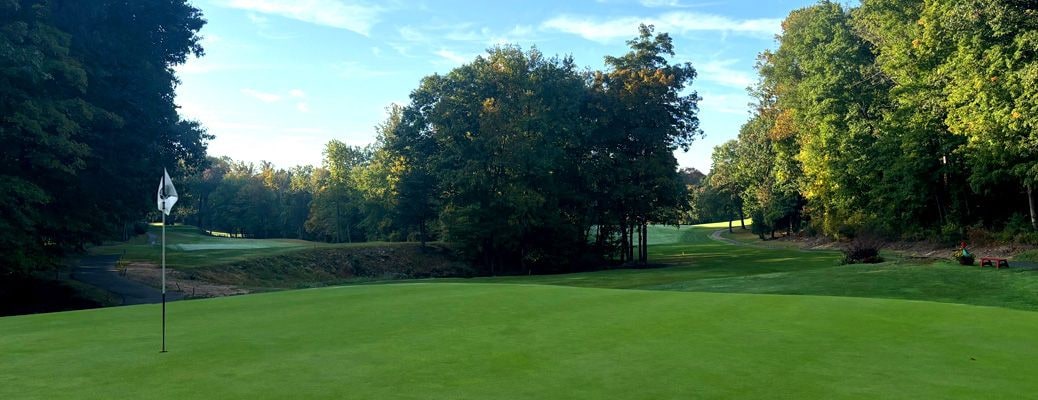
In the early 1920s, Yale's golfers had a problem that only a golf course could solve. The team had won 13 of the first 20 national championships and then gone seven years without another, while Harvard and Princeton played on up-to-date grounds of their own. The belief at the time was simple and a little old-fashioned: great courses make great players. So Yale went looking for a great course, and found a wilderness. The land came to the university in 1923 from Sarah Wey Tompkins, in memory of her husband Ray, a Yale man. It was some 700 acres or more of rock, swamp and dense forest, folded into sudden rises and drops. Charles Blair Macdonald, the preeminent American architect of the day, later called it a veritable wilderness. His name has always hovered over the place, sometimes set beside Raynor's as a co-designer. Yet his hand may have been lighter than the legend. He answered the university's first approach and sat on an advisory committee, and by then he had mostly stepped back from the work. The builder in the field was his protege Seth Raynor, working with his associate Charles Banks. Raynor took steam shovels and dynamite to the hills, with a budget of $400,000 or perhaps nearer $450,000, among the largest sums anyone had spent on golf. The course opened on April 15, 1926. Raynor brought his usual vocabulary: Road, Short, Cape, Biarritz, Alps, Redan, Valley, Eden. But the ground here seems to have resisted formulas, and some of Yale's most memorable holes are ones he had to invent. The 10th, called Carries, climbs 396 yards from the back tees. The fairway rears up immediately and hides the landing area, and a 240-yard drive settles into a swale from which the flag has vanished too. Trees crowd both sides. The green sits 40 feet above the fairway, guarded across its front by a deep bunker, and it is split into two tiers. The 18th, Home, is another original, as hurly-burly as the 10th. Everywhere the scale is outsized. Bunkers drop so deep that wooden steps lead down into them, and from the bottom only a confident sand wedge will save the card. Fairways pitch and roll almost like seaside ground, handing out awkward stances, and the greens are enormous and severely contoured, the kind that make three putts feel like part of the bargain. On the 17th, the slope between tee and fairway was once bare rock, and hickory players grew weary of drives bouncing back toward them until the university covered the ledge in topsoil. To the right of the 14th fairway stands a small carved figure, the last of several elfish shapes that superintendent Harry Meusel's daughter cut from tree stumps in the 1970s. The course has not always been loved as it deserved. For much of the 20th century the university let it drift, and a 1990s renovation by Robert Rulewich wore away more of Raynor's character. Superintendent Scott Ramsay pushed it back toward itself through the 2000s and 2010s with tree management, green expansions and drainage upgrades, but after he left in early 2020 the ground slipped again. Gil Hanse had been asked in 2021 to prepare a master plan, speaking of a place that was massive and grand. After alumni cried out, Yale approved his historical renovation. Work broke ground in early 2024, reaching into greens, bunkers, fairways, tees, drainage, irrigation and trees, and is expected to conclude in the spring or summer of 2026. Yale has hosted every significant championship in Connecticut and two USGA junior events, yet it remains a little hidden. You need a member, a student or an employee to get in, or else a hundred friends for a Monday outing. That suits it. A course carved from a wilderness should still feel slightly hard to reach.
Quick facts
- Location
- New Haven, CT, USA
- Access
- Private
- Year built
- 1926
- Holes
- 18
- Designer
- Charles Macdonald
- Par
- 70
- Length
- 6,779 yards
- Difficulty
- 75.8/137
- Course Vaults score
- 8.5
Getting there
The journey to The Course at Yale begins at Bradley International Airport in Hartford, roughly forty minutes north, or at New Haven's Tweed-New Haven Airport for those seeking a closer, more intimate arrival. From either point, the drive winds through classic New England corridors - stone walls, colonial townships, and the gradual thickening of academic Gothic as you approach Yale's campus. The course itself lies just beyond the university's central grounds, tucked into a quiet residential enclave where the transition from city to links feels almost conspiratorial, as if Macdonald and Raynor carved their masterpiece into a secret corner of the Ivy League world.

FAQ
Common questions about Yale
Ratings, design, and course details pulled from Course Vaults.
Yale has a Course Vaults score of 8.5 out of 10 based on 149 logged golfers.
Yale was designed by Charles Macdonald.
Yale is listed as private on Course Vaults; guest access is typically restricted.
Par at Yale is 70.
Yale plays 6,779 yards from the back tees on Course Vaults.
The slope rating at Yale is 137.