

Pebble Beach Course
Pebble Beach Resorts


Public: #14
Public: #2
Public: #1



About this course
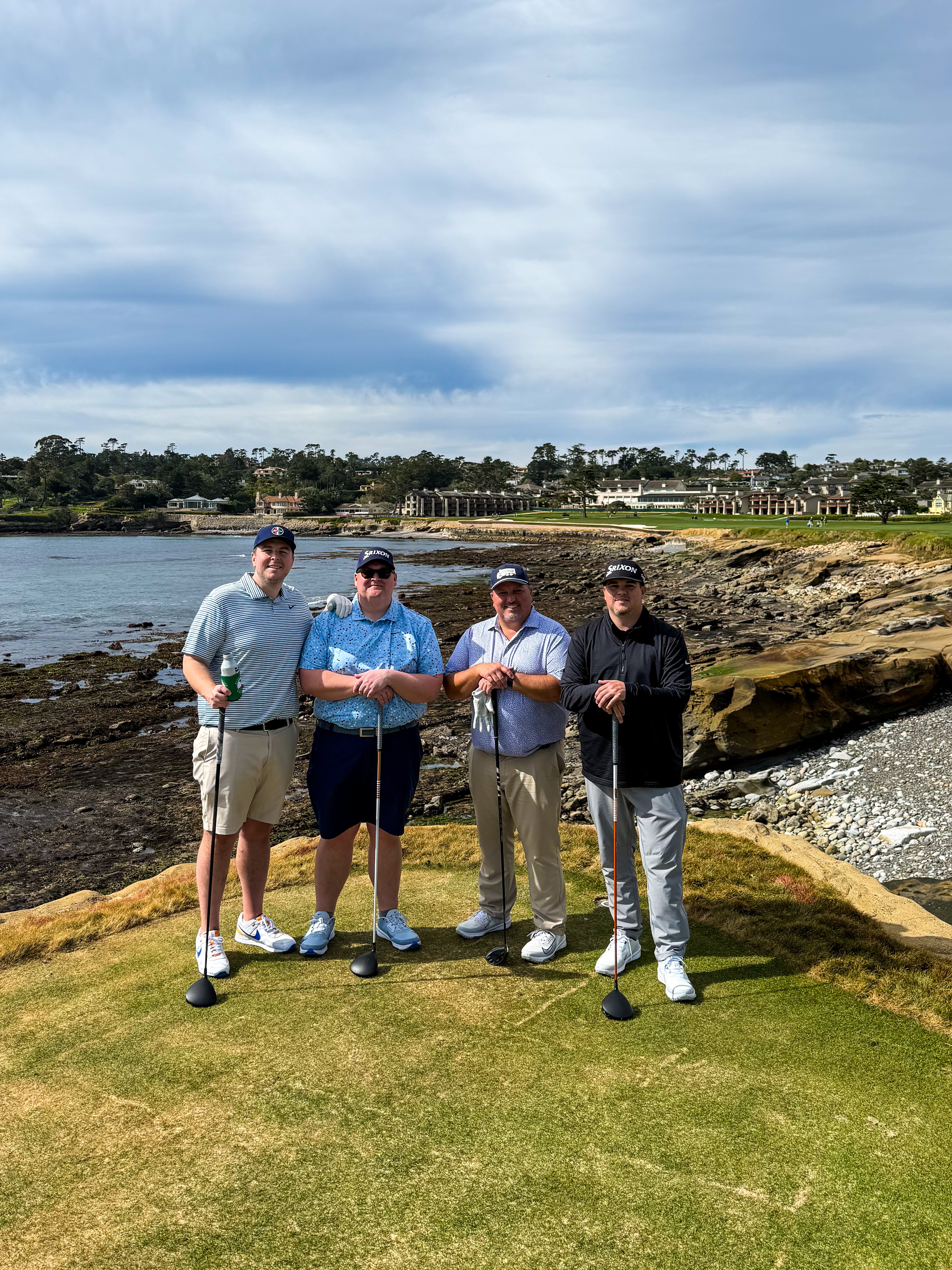
The first thing to understand about Pebble Beach is that it was never sand. It sits on clay and rock, on craggy headlands that fall abruptly into Carmel Bay, and nearly everything that makes it unforgettable comes from that hard, broken edge of California. Robert Trent Jones called it oceanside rather than seaside, because seaside suggests low-lying linksland, and Pebble is the reverse: a course routed along the headlands rather than settled low beside the water. It opened in 1919. Jack Neville laid it out with help from Douglas Grant, who had been the first Captain of Canterbury Golf Club in England, and together they set down a figure-eight routing. Walk it and it can still feel like a classically simple out-and-back affair, the kind that sends you toward the cliffs and brings you home again with your pulse up. Their finishing work was rudimentary, though, and the course began changing almost at once. In 1921 Herbert Fowler took the 18th, then a 379-yard par 4, and stretched it into one of the world's great par 5s. In 1926 Alister MacKenzie rebuilt the eighth and 13th greens to striking effect. Then, ahead of the 1929 U.S. Amateur, H. Chandler Egan remodelled the course, working with Robert Hunter on the rest of the greens and hazards, and gave Pebble the strategic character it has more or less kept ever since. The course you play today owes most to that work. Much later, in the late 1990s, Jack Nicklaus and Arnold Palmer made changes of their own. Some call that a little help from the Golden Bear. Others think a few things might have been better left alone. So Pebble is layered, a palimpsest of hands, and the ground still holds traces of earlier versions of itself. On the ninth there was once a massive fairway in two sections. Only the upper portion, away from the bluffs, is mown today. The lower area is still there, waiting. To the right of the ninth green, hanging above Carmel Beach, sits what used to be the primary 10th tee, and from there the drive becomes a diagonal risk-reward proposition along the edge. Egan once encircled the par-3 seventh with faux dunes, and the late-1920s photographs are lovely to look at, but they belong to a sandier imagination than this clay and rock allow. Seven through ten may be the greatest sequence of holes on the planet, and there lies Pebble's lasting argument. Jones admired the intrepidity with which its builders seized the headlands, yet he could never understand why the interior holes were not given the same shot values. They could not have the gorgeous excitement of the holes along Carmel Bay, he felt, but the same grandeur of design could have been sustained. If you can keep your mind on the game instead of the thundering Pacific, you might card a decent score. If you cannot, take a deep breath and enjoy yourself. Jack Nicklaus never needed persuading. "If I had only one more round to play, I would choose to play at Pebble Beach," he said. "I loved this course from the first time I saw it. It's possibly the best in the world." The professionals have known it since the 1930s, when the tournament now called the AT&T Pebble Beach National Pro-Am began as the Bing Crosby National Pro-Am. It is played across three Monterey Peninsula courses. Once the cut is made after Saturday, the leading pros and pro-am teams come back to Pebble for the final round and a multi-million-dollar purse. In 1937 Sam Snead won $500. That $500 would not cover a single green fee now, which runs well past it and can climb toward a thousand dollars or more. Yet unlike Cypress Point, Pebble Beach is a course anyone can play who is able to pay. For those who are not, coastal access can be free: a parking lot beside the 17th, the steps above Stillwater Cove, the course spread out along the cliffs. Sit there a while and look. You are at Pebble Beach.
Quick facts
- Location
- Pebble Beach, CA, USA
- Access
- Public
- Year built
- 1919
- Holes
- 18
- Designer(s)
- Jack Neville, Douglas Grant
- Par
- 72
- Length
- 7,075 yards
- Difficulty
- 75.9/145
- Course Vaults score
- 9.3
Getting there
The journey to Pebble Beach Resorts most often begins at either San Francisco International or San Jose International, followed by a mesmerizing two-hour drive south down California's iconic Highway 1. Private arrivals flow through Monterey Regional Airport, a discreet gateway just fifteen minutes from the resort gates. The final miles trace the dramatic arc of Carmel Bay, where cypress-studded cliffs give way to the manicured entrance of 17-Mile Drive - a toll road that transforms arrival into ceremony, winding past white-sand coves and windswept fairways before delivering guests to the storied lodges perched above the Pacific's endless blue horizon.

FAQ
Common questions about Pebble Beach
Ratings, design, and course details pulled from Course Vaults.
Pebble Beach has a Course Vaults score of 9.3 out of 10 based on 674 logged golfers.
Pebble Beach was designed by Jack Neville and Douglas Grant.
Yes. Pebble Beach is listed as welcoming public or guest play on Course Vaults.
Par at Pebble Beach is 72.
Pebble Beach plays 7,075 yards from the back tees on Course Vaults.
The slope rating at Pebble Beach is 145.