


Kingston Heath Course
Kingston Heath Golf Club


Public: #10
Public: #1
Public: #1


About this course
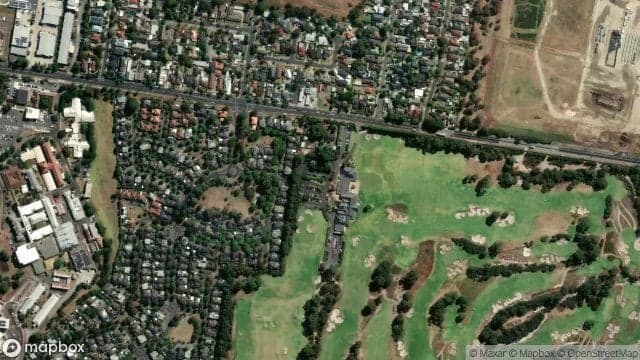
The ground at Kingston Heath does not announce itself. In Cheltenham, on Melbourne's sand belt, the land is mostly flat, and the only large landform the property owns is a sandy bulge at its southern end. A course built here could easily have been forgettable. Instead it became one of the finest textbooks of strategic golf, wringing remarkable excitement out of a relatively unexciting piece of land. The routing belongs to Dan Soutar, a Scottish professional who laid it out in 1925. He seems to have understood that on gentle ground, rhythm is everything. His holes keep changing their minds: long, then short, straightaway, then dogleg, so that the round never settles into a single tempo. The opening hole is a demanding long par four. Soon after comes the 3rd, the shortest par four on the course, and it can be every bit as damaging to a card. Tight bunkering and slick greens prove as lethal as length, and the hole leaves its mark on everyone who tries to overpower it, whether they pull it off or not. The long 6th runs back toward the clubhouse alongside the 1st and stands among the finest par fours in the country. In 1926 Dr Alister MacKenzie came to draw up a plan for the bunkers, and many consider what he left behind to be the best natural bunkering a golfer could wish to meet. He was openly admiring of what he found. "Never yet have I advised upon a course where, owing to the excellence of design and construction work, the problems have been so simple," he said. His bunkers turned Soutar's routing into a running argument on every shot: steer toward safety now and pay for it later, or flirt with danger for a reward on the next one. MacKenzie also suggested a few minor changes, the most famous at the 15th. Soutar had made it a short, drive-and-pitch par four. At MacKenzie's urging it became an uphill par three with a platform green and a terrifying bunker short left. The deep sand seems to overwhelm the small target, and the only real defence is to hit the green. It is one of the stoutest and most memorable holes on the property, though it leaves a slightly awkward walk of 150-plus yards from its green to the 16th tee. That walk leads deeper into the finish. The strategic par five 14th, the mercurial 15th, and then three long par fours of around 400 metres each, with the 14th through 17th all playing with that southern rise in different ways. The 16th doglegs right. The 17th is blind, and its green has no bunkers at all. The 18th is long and tough. Together they ask for pinpoint accuracy from every part of a player's game. The course has been well loved. From the early 1980s superintendent Graeme Grant studied vintage aerial photographs, reinstated bunkers and removed unwisely planted trees, and his work reestablished Kingston Heath among the world's greatest courses. After he left in the late 1990s, Mike Clayton and later his former partners at OCM Golf carried the work on. In 2003 the club added a 19th hole, a par three in the northeastern corner that links the first green to the second tee, resting one of the other par threes during member play and easing gallery flow during tournaments. In 2018 it was redesigned to match the rest of the course. In 2023 came the Furrows, nine par threes of roughly 50 to 150 yards along the eastern edge. The great players have felt it too. Kingston Heath has hosted seven Australian Opens. In 2009 Tiger Woods closed with 68 to win the Australian Masters here, his first stroke play title in Australia, joking that he had now won on every continent except Antarctica. "I really enjoy playing on sandbelt courses because it brings back shot-making," he said. In 2016 Søren Kjeldsen and Thorbjørn Olesen shot 60 in strong southwesterly winds on the way to Denmark's first World Cup. "You don't just get up and whack it," Kjeldsen said, "you've got to think your way around." The Presidents Cup arrives in 2028, and the plain ground will be asking that same question again.
Quick facts
- Location
- Cheltenham, Victoria, AU
- Access
- Public
- Year built
- 1909
- Holes
- 18
- Par
- 72
- Length
- 5,808 metres
- Difficulty
- 76/135
- Course Vaults score
- 9.3
Getting there
The journey to Kingston Heath Golf Club begins at Melbourne Airport (MEL), a straightforward half-hour drive south through the city's leafy southeastern suburbs into Cheltenham. For those arriving by private aircraft, Moorabbin Airport sits just minutes from the club, offering a discreet gateway favored by those who value efficiency and privacy. The final approach trades urban sprawl for the quiet, tree-lined streets of the Sandbelt, where understated signage and a modest clubhouse belie one of the world's most revered golfing grounds - a fitting introduction to a course that has never needed to announce itself.
FAQ
Common questions about Kingston Heath
Ratings, design, and course details pulled from Course Vaults.
Kingston Heath has a Course Vaults score of 9.3 out of 10 based on 23 logged golfers.
Yes. Kingston Heath is listed as welcoming public or guest play on Course Vaults.
Par at Kingston Heath is 72.
Kingston Heath plays 5,808 metres from the back tees on Course Vaults.
The slope rating at Kingston Heath is 135.
Kingston Heath is a 18-hole course.