
Championship Course
Cherry Hills Country Club


About this course
In the early 1920s Denver was growing faster than its favorite country club could hold, and a group of Denver Country Club members went looking for room to breathe. They wanted a club built around the game itself rather than the social life that surrounded it. The land they found held a cherry orchard and a set of gentle rolling hills, and they named the place for both. By 1922 they had hired William Flynn, the premier architect of the day, fresh off extensive work at Pine Valley. Flynn spent a month in Denver, and in that month he gave the club a routing with something of Muirfield in it, along with detailed hole-by-hole construction plans drawn to scale and annotated with specific instructions. He also drew up a plan to redesign Denver Country Club while he was there. Then he left, and a local crew built the course from his drawings. There is something tender in that image: a month of a master's attention, then a town's own hands following the lines he left behind. What he left was rugged. Several holes had breaks in the fairway, a Flynn signature. There were expansive sandscapes broken by grass islands, and rugged grassed mounds that recalled Pine Valley. Flynn also planted trees on purpose, on the inside and outside of doglegs and in places meant to deceive the eye, so that even a skilled player might misjudge what lay ahead. And he built a finish meant to settle things. The last five holes were designed to minimize the chance of a playoff, and par on each of them is a good score. Nearly fifteen years after the course was completed, Cherry Hills hosted the 1938 U.S. Open, the first played west of Minneapolis. Hosting the game's biggest events quickly became the club's identity. Multiple majors followed, along with various USGA championships and a PGA Tour event, more than a dozen elite competitions over the decades. Across those years the course was altered several times, some changes small and some far-reaching. Before the 1960 U.S. Open, dramatic changes removed much of Flynn's original work. The great cross hazard on the 17th, modeled on Hell's Half Acre at Pine Valley, was taken out. Hundreds of trees went in along the fairways, and many of the angles Flynn had drawn so carefully closed up behind them, taking much of his strategy with them. In the 1970s Arnold Palmer's design firm prepared the course for the 1978 U.S. Open, making it tougher by adding and remodeling bunkers in a new style and stretching the scorecard. Eric Iverson and Tom Doak brought much of it back through a long restoration. Today the original routing holds, and most of Flynn's design features are still in place. Hundreds of trees have come down, and the playing corridors have opened again. The course still lives with a tension it has not quite resolved. The bones are Flynn's, but the skin is something else. Where there were once rugged bunkers, rough mounds and sparsely wooded hillsides, there is now ample maintained rough and mature timber, the look of a classic parkland course. Even after the clearing, more trees stand here than Flynn intended, and the turf presentation gives the round a certain sameness, one hole running into the next in shades of green. You can feel the old architecture underneath, the breaks and angles and the quiet deceptions, waiting to be seen more clearly. That is the romance of Cherry Hills. It is a championship ground still finding its way back to the orchard hillside a careful man studied for a month in 1922 and then left in other hands.
Quick facts
- Location
- Englewood, CO, USA
- Access
- Private
- Year built
- 1922
- Holes
- 18
- Designer(s)
- William S. Flynn, Press Maxwell
- Par
- 72
- Length
- 7,348 yards
- Difficulty
- 73.2/140
- Course Vaults score
- 8.6
Getting there
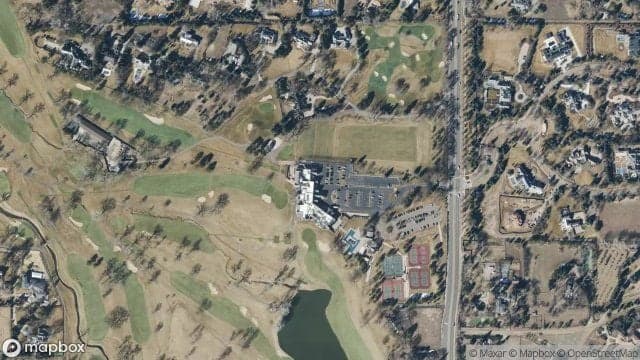
The journey to Cherry Hills Country Club begins at Denver International Airport, roughly thirty minutes northeast of the club's storied grounds in Englewood. From the terminal, the drive southwest traces the Front Range foothills, trading high plains for the leafy, manicured neighborhoods that shelter one of America's most storied private clubs. The final approach along South University Boulevard feels like a passage into rarefied air - literally and figuratively - as the Rocky Mountains rise sharply to the west and the discreet entrance to Cherry Hills appears, a quiet threshold to a century of championship golf and Denver society.
FAQ
Common questions about Championship at Cherry Hills Country Club
Ratings, design, and course details pulled from Course Vaults.
Championship at Cherry Hills Country Club has a Course Vaults score of 8.6 out of 10 based on 39 logged golfers.
Championship was designed by William S. Flynn and Press Maxwell.
Championship at Cherry Hills Country Club is listed as private on Course Vaults; guest access is typically restricted.
Par at Championship is 72.
Championship plays 7,348 yards from the back tees on Course Vaults.
The slope rating at Championship is 140.